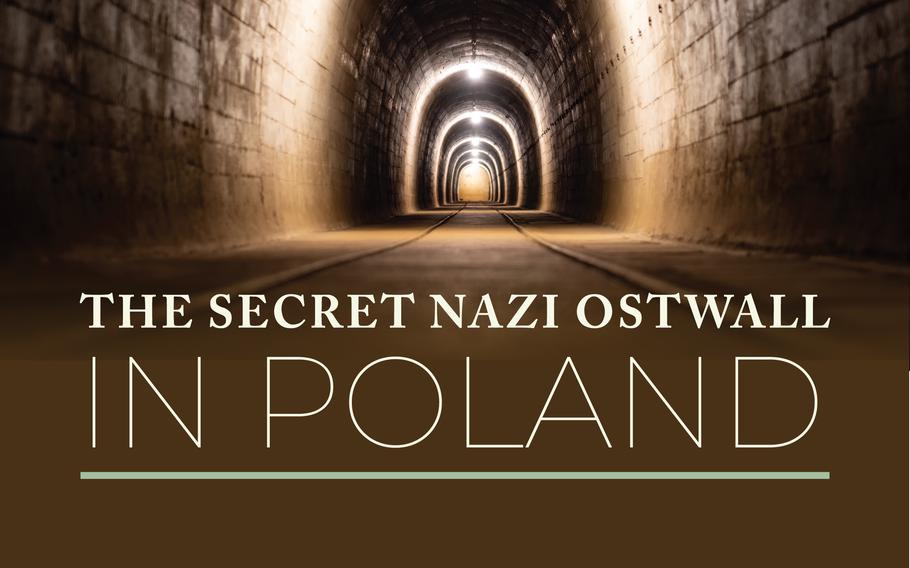
In Poland you can visit an underground network of secret Nazi tunnels called the Międzyrzecki Fortified Region, part the “Ostwall” defence. (Designed by Stars and Stripes)
After World War I, the Treaty of Versailles explicitly prevented Germany from building fortifications along their borders. But plans to secretly secure the eastern border with Poland were being hatched as early as 1927, and with Hitler’s rise to power as Chancellor in 1933, development took off.
The “Ostwall,” or eastern wall, was established as a series of natural waterway barriers. However, a strip of land between the Oder and Warta rivers was a natural gateway that needed extra fortifications. A “fortified arch” between the rivers was built piecemeal beginning in 1934 as seemingly incongruous structures and anti-tank barriers.

The secret construction project was 80km long and officially approved by Hitler during his visit in 1935. (macko (Adobe Stock))
Source
The secret construction project was 80km long and officially approved by Hitler during his visit in 1935. The entire route was divided into three sections, with each containing around 100 facilities armed with modern weaponry.
The true secret though, was below ground where over 35 kilometers of tunnels connected the buildings in the central section. There were workshops, storage spaces, social areas and barracks large enough to house 24,000 soldiers. Train tracks and stations were built in the underground space and a “main traffic road” connected it all together.
At the start of World War II, however, efforts were needed elsewhere, so the project was halted with much of the above-groundwork left unfinished. The front didn’t see much action during the war and was used as a Daimler aircraft engine factory. Finally, in January of 1945, the small crew stationed at the facility was overrun by Russian forces.

The central section was centered around the town of Międzyrzec and is now called the Międzyrzecki Fortified Region or MRU. (Maurice Tricatelle (Adobe Stock))
Source
The central section was centered around the town of Międzyrzec and is now called the Międzyrzecki Fortified Region or MRU. There are two access areas open to the public with guided-tour access. The MRU Museum and Fortifications in Pniewo has year-round underground tours that range in length and adventure. Only 10 minutes down the road is a second access point at the Boryszyn Loop where you can book either a walking or biking tour of the underground spaces.
The MRU tunnels were highly suspected of being the hiding place for Nazi treasures and stolen artworks, however,as of now, none have been found. The tunnels were abandoned after the war and most ground-level buildings were destroyed or looted. As a result, the MRU is now the largest bat refuge in Europe with thousands of nocturnal residents from 12 different species.


